
A Curiosity
Why do they call it a murder of ravens?

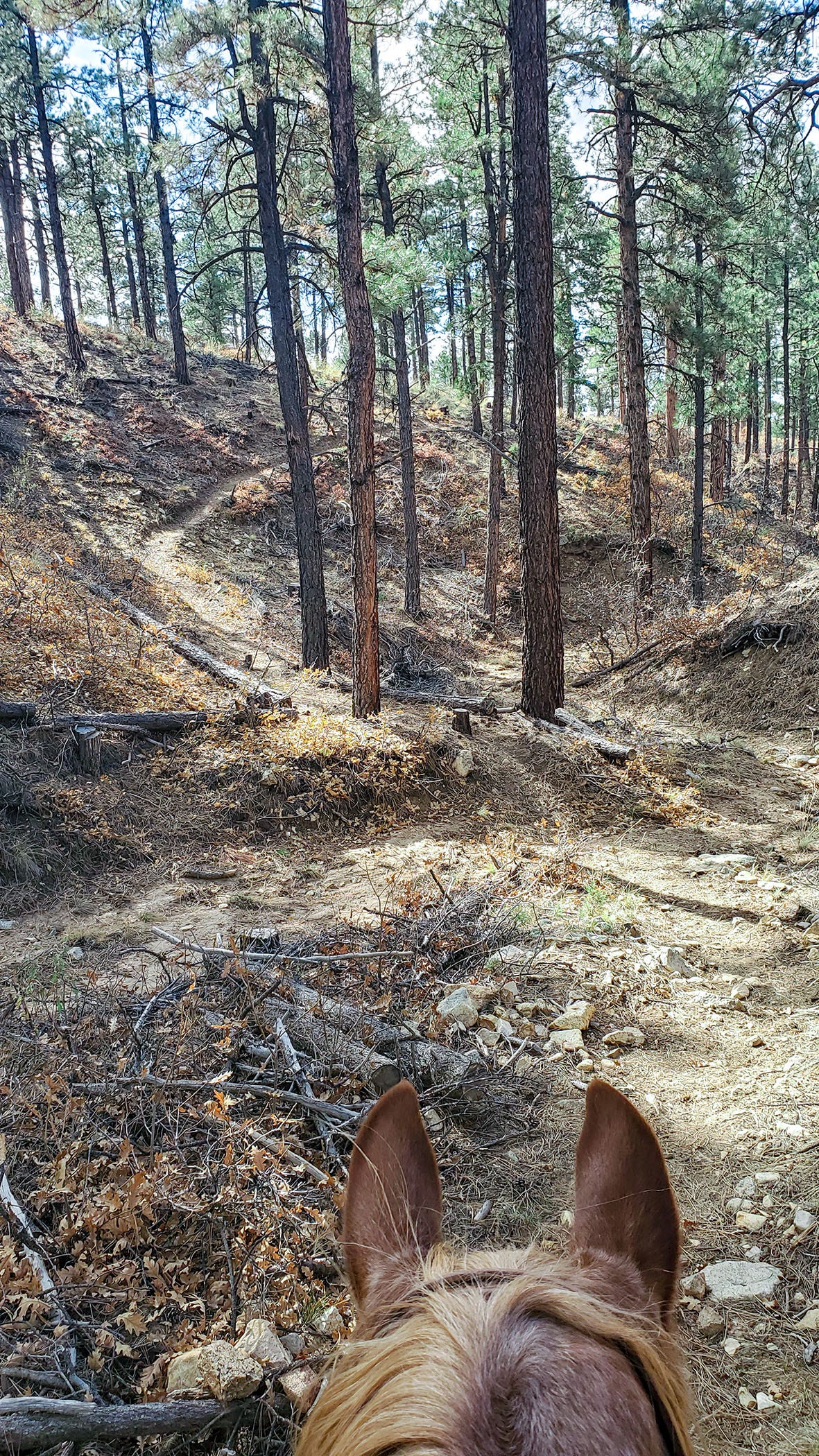
Mid-May, the winds resume, not that they ever leave for long these days. Having returned from our Utah road trip, Bob and I look forward to getting back in the saddle to ride our horses into the National Forest that abuts our northmost property boundary. Yesterday, 40-mile-per-hour winds blasted dust squalls through the corral. Trees dropped pinecones and suspended dead branches. Horses don’t really like going out in such wild weather.
Today, gentle breezes have not yet gained in velocity. The temperature barely moves from 59 to 62 degrees, perfect riding weather in that regard. We travel west toward a path that follows the forest fenceline, before crossing a deep arroyo. Bob cut a route down one side and up the other a few years ago, after a Forest Service thinning project described as lop and scatter, indiscriminately spread scraggly branches pretty much everywhere, blocking established trails. The leñeros, or local Hispanic woodcutters, collected the more usable-sized tree trunks and bigger pieces of firewood, discarding the treetops and branches as instructed.
The two horses, Jalisco and Hickory, step briskly, crossing the arroyo and climb up the other side. We traverse a second, deeper arroyo to reach an east-facing slope where we can drop below the ridge and be protected from building wind gusts. The shaded forest passageway cools the morning air. Trees from the bottom of the canyon rise to eye level, exposing upper canopies to our view. At first, we notice a single raven shadow gliding overhead. Its dark shape, projected on the ground, looks much bigger than an actual bird. It is momentarily followed by others, flying in small groups. The horses are familiar with a pair of ravens that live around our house. They come to drink from their water trough and hang out in a nearby ponderosa tree, waiting for Bob to put out any mice caught in the grain shed. But now the corvids appear in growing numbers. Dark obsidian wings flap out from the treetops and hidden branches. From a standstill, they suddenly fly up from the ground. My bay mare, Hickory, is uneasy about their startling approach, seemingly from all directions. The birds are quite vocal, cawing as they pass overhead, squawking as they turn. In twos and threes, they synchronize their swerves and dives to soar close above our heads. The familiar sounds, the clucks, the odd ‘uh-oh’, the gargled throat chortle, just about their entire vocabulary vibrates from earth, sky, and everywhere in between. What an unusual situation.
Of course, our first assumption is that something lies dead somewhere. Last year, Bob found a deer carcass by following circling scavenger ravens in that vicinity. However, these ravens are not localized. Instead, they spread out over a large area throughout the pine forest. We do not observe a central epicenter of activity, and maybe don’t really want to, as the horses are already reacting nervously to the wind, the flash of shadows, and the unanticipated birds themselves. Coming close to a dead creature being devoured by predators could send them into a survival, panicked flight. We continue along the accustomed trail, hoping the familiarity will at least add a calming element. Our track eventually joins a back entranceway to the Lawrence Ranch, where the ravens follow us down the mile-long dirt road back to our house. At this point, we have encountered well over a hundred birds.
With the horses’ safe arrival at home, free of incidents, good horses that they are, Bob and I decide to hike back into the woods to see if we can discover a reason for this unique flock behavior. Bob grabs his .22 in case all the ruckus involves a mountain lion or bear feeding on a carcass of some kind. The gun won’t kill anything large, but it might scare them off. We retrace our tracks across the first arroyo and head towards the second one. Ravens are still flying about through the trees, sitting in the ponderosa branches, and hopping around on the ground, but the number has diminished. It’s a guessing game as to where dead remains might be. We search by walking a grid pattern for a while. At first, we thought there might be outlier birds waiting on the periphery, while the more dominant members of the raven society got first pickings. But that does not seem to be the case. One other time, we witnessed a murder of ravens below Wheeler Peak, where a feeding frenzy on rock moths took place. As yet, no insect hatch is obvious. We believe they are definitely feeding on something. However, in all truth, we are entirely baffled. We sit in the shade of Douglas fir and spruce trees, watching the birds surf the wind currents with incredible skill. Their flight is swift and unpredictable. I do my best to snap a flyby photo of their aerial acrobatics. Trying to capture them with my cell phone lens is dizzying. Best to relax and enjoy the show.
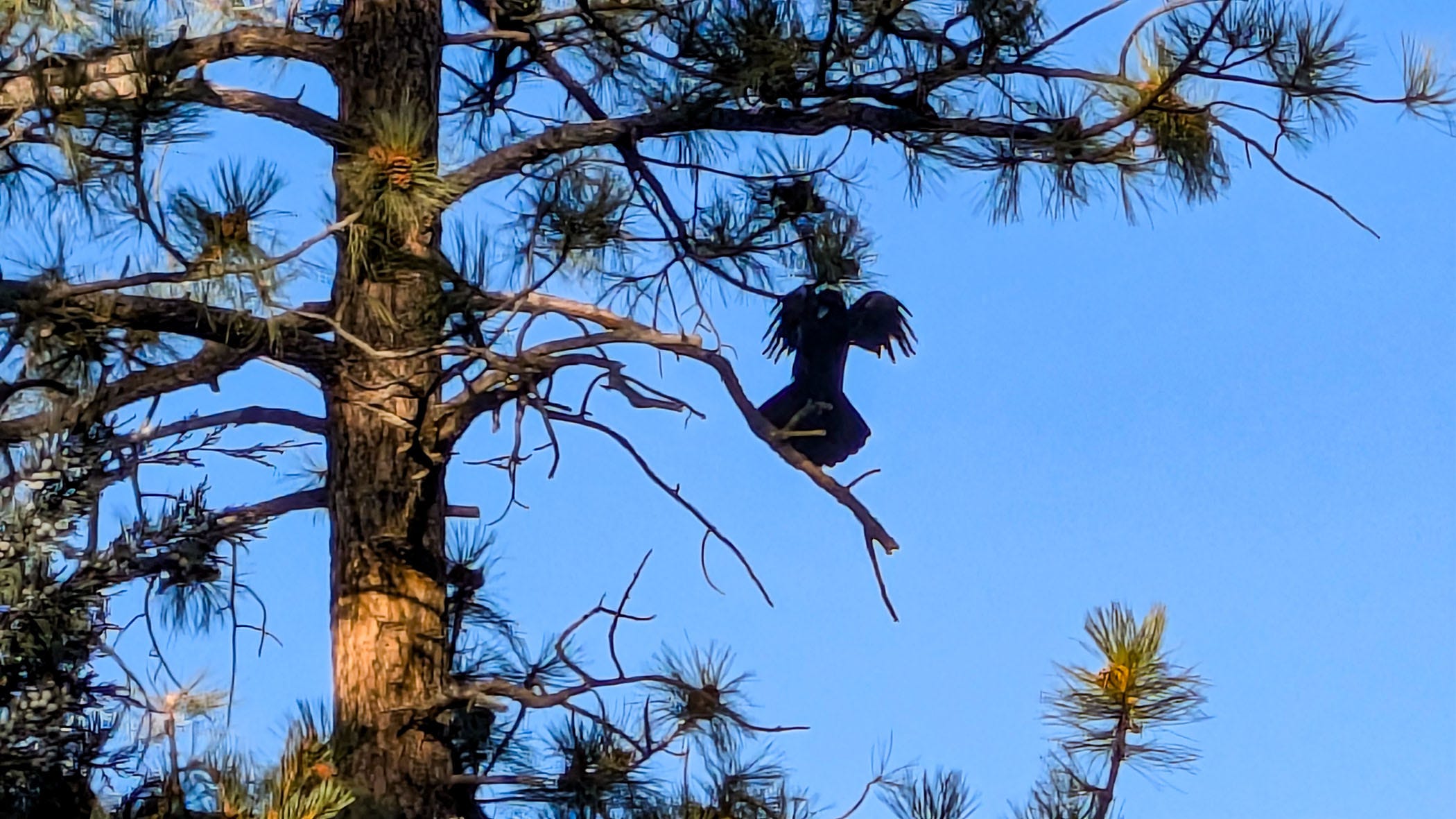
While I am hoping for a dramatic ending to this tale, all I am left with is a mystery. What caused this peculiar gathering? Maybe when riding another day, we will come across a well-cleaned carcass. For now, we have no explanation, only unanswered questions and an unresolved curiosity.
Post Script:
The following day, when I took down my laundry from the clothesline, I discovered a cicada tucked away in a fold. Three days later, cicadas started clicking in the trees. So, we guess they were there all along, perceived by raven intelligence, unavailable to these two humans.
For the most part, cicadas live underground but crawl up tree trunks, plants, and other outside surfaces like walls to shed their exoskeletons. They emerge annually when the soil gets warm and exit from their outer skin as winged adults. They do not swarm and are considered harmless. Their mating call can reach 100 decibels.
.
I have had Ravens nesting in a large spruce outside my front door for over 15 years. Twice we have had family reunions of scores of birds who show up and hang out for several days, maybe a week or so. My friend Pat Beasley has seen the same thing at his place in Tesuque, but he had pretty clear indication of what was going on. One evening he found a sickly Raven at the foot of its' tree, he propped it up and when he checked on it the next morning it had passed away. Not having time for a burial before he went to work, he put the corpse on the roof of the guest house so the dogs wouldn't get into it. He planned to take care of it that afternoon. Then the crowd began to gather. And gather, and gather. It seems to have been a wake, a paying of respects. I certainly think it's what could have been going on. Complex critters they are.
Since spring we’ve had a mischief of magpies in our neighborhood. They have chased away the smaller birds and the ravens have kept their distance.